Your First Basketball Game: Follow One Possession
Follow one basketball possession from the rebound or inbound to a shot or turnover, and see how the clock, spacing, passes, and defensive pressure shape it.
How do you follow a basketball possession when the players seem to move all at once? For your first basketball game, choose one team’s trip with the ball and track it from the moment possession changes until a shot, turnover, or other stoppage ends the action. You do not need to identify every play. Watch for a few visible cues, and the sequence starts to make sense.
The plan below works from the stands or on a screen. Follow the ball first, then glance at the clock, the players without the ball, and the defense. Each possession has its own small story: a team gets control, tries to create a useful chance, and either takes a scoring attempt or loses the ball.
1. Find the start
A possession begins when a team gains control. That might happen when a player collects a rebound after a missed shot, intercepts a pass, picks up a loose ball, or receives the ball after it is put back into play. An inbound pass is the easiest start to recognize: a player stands outside the boundary line and passes to a teammate on the court.
As soon as the team has the ball, pick one player to track: whoever is dribbling, passing, or carrying the ball forward. Don’t worry yet about the names of the positions. You are simply asking: who has the ball, and which basket is that team attacking?
Basketball’s direction changes between periods, so use the current play rather than assuming a team always attacks the same end. The scoreboard, court markings, and players’ movement can help you orient yourself. Once the ball crosses into the attacking half, keep your attention on that end.
Start with the moment of control, not with a player’s run before the ball arrives.
2. Read the clock
Look for two clocks, if they are visible. The game clock tracks the period; the shot clock tracks how long the offense has to attempt a shot. Their precise rules can vary by competition, so for a first viewing just notice whether the shot clock looks generous or nearly expired.
A fresh possession often gives the offense time to bring the ball forward and arrange its players. When the shot clock is low, the team may have to shoot sooner or make a quick pass to someone in a better position. That pressure can explain a hurried attempt that otherwise seems puzzling.
You may also see the game clock stop, restart, or change after a whistle or a score. Treat those changes as context, not as a second puzzle to solve. First follow what the players do with the ball; then check whether time pressure helps explain their decision.
A low shot clock is a clue to urgency, not a prediction of what the team will do.
3. Notice the spacing
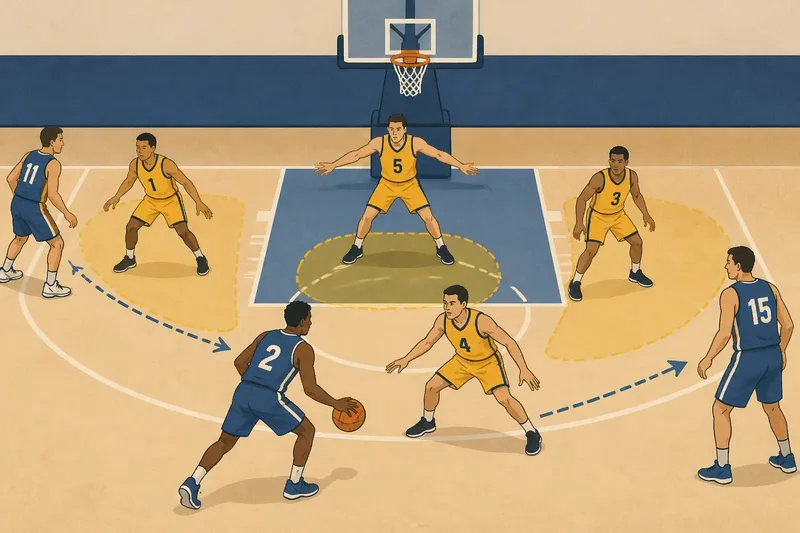
Once the offense is set, scan beyond the ball. Are teammates spread around the court, or clustered near the player handling it? Do they stand near the three-point arc, move toward the basket, or wait along the baseline? Their locations matter because they can open a driving lane, make a pass available, or pull defenders away from the ball.
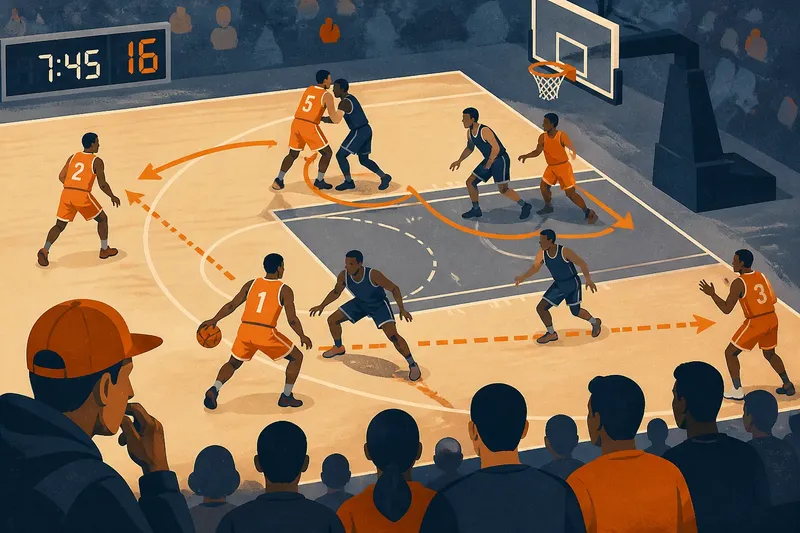
Look for a gap between the ball handler and a defender. If the defender stands close, the handler may pass, dribble away, or use a teammate’s screen. A screen is an attempt to make the defender take a longer route by placing an offensive player in the defender’s path, within the rules. Watch what happens next: does the handler turn the corner, pass to the screener, or keep the ball?
Do not try to follow every off-ball movement. Pick one teammate near the ball and see whether that player cuts toward the basket, moves to the wing, or stays in place. That one movement can make a later pass easier to understand.
Spacing is easier to read when you watch one useful route, not five at once.
4. Track the defense
Follow the nearest defender as the ball handler changes direction. The defender may stay in front, reach toward the dribble, switch to a different attacker after a screen, or give ground to protect the path to the basket. These are visible reactions; you do not need to know the defense’s name to notice them.
Then glance at the other defenders. Are they close to their own opponents, or are some stepping toward the ball? A defender who helps may leave another attacker open. The offense can respond with a pass toward that space, while the defense tries to recover before the receiver can shoot.
Say you’re watching an invented possession in which a guard dribbles toward the right side and a defender blocks the direct route. A teammate moves closer and sets a screen; the guard turns around it, while a second defender steps over to help. You would expect the guard to have a choice: pass to the teammate rolling toward the basket, find an open player farther out, or take the shot if the defense leaves room. You’re not predicting the result; you’re watching how each action creates the next choice.
The defense can tell you where the offense may look next.
5. Follow each pass
When the ball moves, follow it to the receiver, then quickly check where the passer goes. A pass may be a simple way to keep the possession moving, or it may shift the defense enough to create a better angle. The receiver might shoot, dribble, pass again, or hold the ball while teammates reposition.
Notice whether the pass travels across the court, toward the basket, or back away from pressure. A cross-court pass can move the defense from one side to the other. A pass inside may put the receiver closer to the hoop, but defenders can crowd that area. The result depends on the defenders’ position and the receiver’s room to act.
Also watch for a pass that never reaches its target. A defender may deflect it, or an intended receiver may fail to secure the ball. If the other team controls it, the possession has changed. Follow the new ball handler rather than continuing to track the team that just lost it.
After every pass, ask whether the receiver gained room, lost room, or simply moved the ball along.
6. Recognize the ending
A possession ends with a scoring attempt, a turnover, or a stoppage that gives the ball to the other team. A shot can go in, miss, or be blocked. If the offense gets its own rebound, it may keep possession and begin another attempt; if the defense secures the rebound, the defending team takes over.
A turnover is a loss of control, such as an intercepted pass, a player stepping out of bounds with the ball, or an offensive foul that gives possession to the opponent. The whistle tells you that play has stopped, but the official’s signal or the next inbound can help show which team gets the ball. If you miss the signal, watch who puts the ball back in play.
Don’t treat every shot as the end of the whole sequence. A missed shot followed by an offensive rebound is still part of the same team’s effort to score. For your first possession, you can stop once a shot is taken, then notice who collects the rebound and whether a new possession begins.
The clearest endpoint is control: which team has the ball after the attempt or whistle?
7. Try the full sequence
Put the cues together on one ordinary possession. Imagine an invented game in which the blue team collects a defensive rebound. A guard brings the ball up; the shot clock has room, so the team spreads out. One defender meets the guard, a teammate sets a screen, and the guard passes to a player near the wing. That player dribbles once, shoots, and misses. A blue teammate grabs the offensive rebound, so blue still has control and can begin another attempt.
In that sequence, the useful observations were straightforward: who gained the ball, how the offense spaced itself, how the defense reacted, where the pass went, and who controlled the rebound. You could add more detail later, such as the score or the type of shot, but those details are optional for following the basic action.
- Start: Identify the team that gains control.
- Direction: Note which basket it attacks.
- Pressure: Check the shot clock and the nearest defender.
- Movement: Watch one teammate without the ball.
- Decision: Follow each pass, drive, or shot.
- Finish: See who controls the ball after the attempt or whistle.
If you lose track of the ball, look for the next inbound or the player holding it after a rebound. Then start again from that moment. Following one basketball possession this way gives you a reliable foothold in the game: the action becomes a chain of visible decisions, even when the rest of the court is moving quickly.