Why the Offside Line Moves with the Play
Understand the football offside line at the instant a teammate plays the ball, so you can tell why a forward position may become onside a moment later.
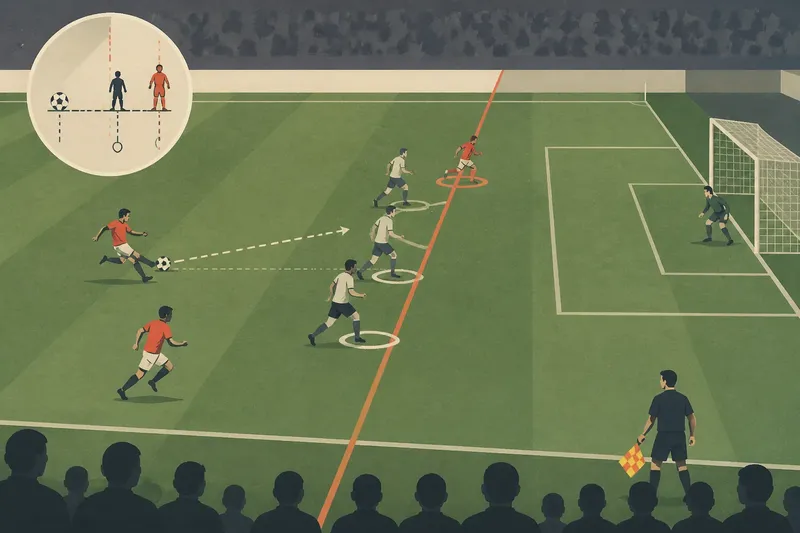
Why does a forward look offside one moment and perfectly legal the next? The football offside line moves with the play because officials judge a player’s position when a teammate plays or touches the ball, not when the pass arrives. Once you track that instant and the defenders’ positions, the shifting line becomes much easier to read.
Start with the right instant
The first common mistake is judging the attacker when the ball reaches them. That feels natural: the pass arrives, the runner is beyond the defenders, and the flag goes up. But the relevant snapshot is earlier, at the teammate’s touch that sends the ball forward.
Imagine a midfielder shaping to pass while a forward waits level with the last defender. At the instant the midfielder kicks the ball, the forward darts beyond that defender. If the forward then receives the pass, the run began from an onside position; their later location does not make that earlier position offside.
Try pausing your attention at the passer’s contact, rather than following the ball all the way to the receiver. That is the frame to assess.
Find the second-last opponent
The next snag is treating the goalkeeper as the offside line. The rule does not say an attacker must always have two outfield defenders ahead. Instead, an attacker is in an offside position if nearer to the opponents’ goal line than both the ball and the second-last opponent at the relevant moment.
The goalkeeper is often one of those opponents, but not necessarily. A goalkeeper may have come out to challenge, leaving another defender nearer the goal line. In that case, the second-last opponent could be a field player or, depending on the positions, the goalkeeper.
To read a crowded scene, locate the goal line, then count the opponents from that end of the field. The second one gives you the defensive reference. Compare the attacker with that opponent and the ball; being level with the second-last opponent is not an offside position.
Track a moving reference
People often picture the offside line as a stripe painted across the field. It is only a temporary reference based on the ball and the second-last opponent, so its location can change as play develops. A defender stepping toward midfield can move the reference forward; a defender retreating toward goal can move it back.
The ball matters too. If the ball is closer to the opponents’ goal line than the second-last opponent, the ball sets the relevant limit. That is why a forward near the goal can still be onside if they are behind the ball when a teammate plays it.
Rather than memorizing where the line was a second ago, rebuild the picture at each teammate’s touch. The reference belongs to that moment, not to a fixed patch of turf.
Separate position from involvement
Another frequent confusion is assuming that every player standing in an offside position has committed an offense. Position alone is not enough. The player must become involved in active play, such as by playing or touching the ball, interfering with an opponent, or gaining an advantage from a rebound or deflection, as defined by the rules.
For instance, an attacker may stand beyond the second-last opponent while a teammate passes to someone else. If the attacker does not affect an opponent or gain an advantage from the play, simply being there does not automatically mean offside. Watch what the player does after the pass, not only where they were at the pass.
This distinction also explains why an assistant referee may wait before raising the flag: the decision can depend on whether the player in that position becomes involved.
Check the type of play
Viewers sometimes apply the moving-line test to every restart. A player cannot be offside directly from a goal kick, throw-in, or corner kick. Once a teammate touches the ball in subsequent play, the usual offside assessment applies again.
There is also a crucial difference between a deliberate play by a defender and a deflection or save. A deliberate play can affect whether an attacker’s earlier position matters; a mere deflection or a goalkeeper’s save does not automatically reset the assessment. The exact decision depends on the circumstances of the play, so avoid assuming that any defensive contact erases the original position.
If the situation turns on a technical detail, the competition’s current rules and the referee’s judgment govern. For an ordinary live-play read, first identify who last touched the ball and whether the touch was a teammate’s pass or a defender’s deliberate play.
Why does the line seem to jump?
Why can a forward be beyond the defender but onside?
The forward may have been level with the second-last opponent, or behind the ball, when the teammate played it. The forward’s position at arrival does not replace the snapshot at the pass.
Does the goalkeeper always set the line?
No. Count the opponents nearest their own goal line; the second-last opponent is the reference unless the ball is nearer the goal line. The goalkeeper often occupies one of those positions, but can be elsewhere.
Does an offside position always stop play?
No. The player must become involved in active play in a way covered by the rule. A player away from the ball may remain uninvolved, though their effect on an opponent can still matter.
Why does the assistant referee wait to signal?
The assistant may delay a signal when the player’s involvement is not yet clear. Waiting lets play develop enough to see whether the player in an offside position actually affects the action.
Use a quick viewing routine
When a close call leaves you unsure, replay the sequence in this order:
- Find the exact teammate touch that sends or redirects the ball.
- At that instant, locate the second-last opponent and the ball.
- Check whether the attacker is nearer the goal line than both; being level is onside.
- Watch whether the attacker then plays the ball, challenges an opponent, or gains an advantage.
- Check whether the action began directly from a restart that exempts the player from offside.
Say you see a winger sprint beyond a retreating defender as a teammate passes. If the winger was level at the teammate’s touch, the later gap does not change the call; if the winger was already beyond both the defender and the ball, involvement may make the position an offense. Replaying the right instant, rather than tracing a permanent stripe across the field, is the simplest way to understand why the football offside line moves with the play.