Man-to-Man or Zone Defence: Who Owns the Space?
Man-to-man or zone defence changes who is responsible for each opponent and patch of court. Learn to spot the trade-offs as a possession unfolds.
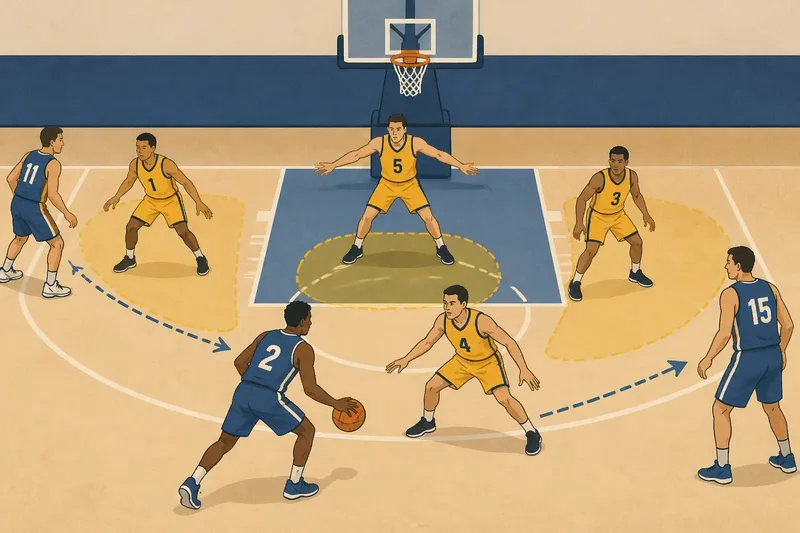
When a defender leaves an attacker to close a passing lane, is that a mistake—or a sign the team is playing zone? Man-to-man or zone defence is easiest to understand by asking who owns the space as the ball moves: a particular defender tracking an opponent, or a group protecting an area. That distinction shapes what you see on every possession, but real defenses often blend the two.
Two kinds of responsibility
In man-to-man defence, each player is primarily responsible for an opposing player. The assignment may change after a screen, a cut, or a switch, but the basic reference point is a person. A defender follows that opponent around the court while also trying to stay positioned between them and the basket.
In a zone, defenders begin with areas to protect rather than fixed opponents. A player near the top may challenge the ball, while teammates guard the middle and the corners. If an attacker enters one defender’s area, that defender engages; when the attacker moves on, responsibility can pass to another teammate.
Neither description means a defender ignores everything else. Man-to-man players help when a teammate is beaten, and zone players still have to identify and contest individual attackers. The difference is the default answer to “Who should respond here?”
Watch the players away from the ball: their movement often reveals that answer before the ball-handler does.
Tracking opponents
Man-to-man defence can make an offense feel closely followed. A player who cuts toward the rim may draw a defender with them; a player standing outside may have a defender ready to contest a catch. This can disrupt the offense’s timing and make a pass look less inviting.
The approach also asks defenders to manage the space around their assignments. If an attacker sets a screen, the defender must get around it, exchange assignments with a teammate, or use another team-agreed response. A late decision can leave the ball-handler open or create a brief mismatch, such as a slower defender guarding a quick ball-handler.
One useful visual cue is whether defenders keep matching the same attackers as those attackers cross the court. If they do, that points toward man-to-man. But a defender may hand off an opponent at a screen or when a cutter enters a teammate’s area, so one exchange alone does not settle the question.
In a hypothetical possession, imagine a guard dribbling around a screen while the screener rolls toward the basket. One defender follows the guard around the screen and a teammate stays with the roller. If both keep their assignments, the ball-handler may have less room to turn the corner; if they switch, the offense may try to exploit the new matchup.
Protecting areas
A zone can place defenders between attackers and the most valuable routes to the basket. Instead of following every cut across the whole floor, a defender may stay near a central area and take responsibility for whoever enters it. That can make interior passing lanes harder to use and provide nearby help against a drive.
From the stands, look for a coordinated shift. When the ball moves from one side to the other, several defenders may slide together, each maintaining a relationship to the ball and the area they guard. Their positions can look like a shell that narrows around the ball and keeps a defender close to the middle.
That structure also leaves choices for the offense. A pass to an open area may force defenders to rotate, with one player closing out while another covers the newly exposed space. If the pass moves faster than the defense can shift, a shooter may receive the ball with time to make a play. If defenders recover in order, the apparent gap may close before the receiver can use it.
Zone does not mean “stand still and guard a patch.” It involves communicating, moving as a unit, and recognizing who should challenge the ball without abandoning a dangerous area.
What gives the defense away?
One snapshot can be misleading. A defender may stop following an opponent because a teammate has taken over, or several defenders may briefly collapse around the ball in a man-to-man scheme. Read the sequence: notice what happens when attackers cross, cut, or screen, and how the defense responds when the ball changes sides.
- Track a cutter: Does one defender travel with the attacker across the court, or does a teammate pick them up near a boundary between areas?
- Watch the ball-side shift: Do defenders move together while keeping positions around the lane, or do they stay attached to particular opponents?
- Notice the screen: Do defenders chase around it, exchange assignments, or have one player step out while another recovers?
- Check the weak side: Do off-ball defenders appear ready to help from a central position, or are they closely guarding their own assignments?
No single cue proves the scheme. A team can change its approach during a game, and a possession can include a planned switch or a temporary double-team that resembles a different defense.
The trade-off in plain sight
Man-to-man makes opponent tracking its organizing principle. That can make it harder for attackers to move freely without being noticed, but screens and rapid cuts can test communication and create brief openings. The defense must decide whether to preserve the original matchups or exchange them.
Zone organizes defenders around space. It can keep help close to important areas and make drives into traffic less comfortable, but it asks players to rotate together as the ball moves. An attacker who reaches an uncovered spot at the right moment may make the defense choose between closing out and protecting the area behind them.
These are tendencies, not automatic outcomes. A well-coordinated zone can pressure a receiver, and man-to-man can include strong help. The practical difference for a viewer is the starting responsibility: follow this opponent, or guard this area and pass attackers along as they move through it.
Why defenses blend
Some possessions do not fit neatly into either category. After a switch, two defenders may temporarily guard the opponents nearest them, while teammates sort out who has which assignment. A team may also use man-to-man principles around the ball and protect the lane with help from players away from it.
Those moments make more sense if you distinguish the initial plan from the adjustment. A defender who steps out to stop a drive may leave their assignment briefly, but a teammate can cover the open attacker until the first defender recovers. That is help within a man-to-man structure, not necessarily a change to zone.
Likewise, a zone defender may follow an attacker for several steps because that player is moving through a dangerous area. The defender may then hand the attacker off rather than continue tracking them across the floor. Look for whether teammates take over in a coordinated pattern, not just whether one player moves away from a spot.
Questions viewers ask?
Can a team change defenses during a game?
Yes. A team can use one scheme for a stretch and another later, or vary its coverage in response to a particular lineup or situation. Look for the defenders’ repeated responsibilities across several possessions rather than assuming the first pattern will continue.
Does a zone mean nobody guards the shooter?
No. A zone defender should challenge an attacker who receives the ball in their area, and teammates may rotate to cover the space left behind. The question is how those responsibilities are shared, not whether the offense can shoot freely.
What does switching mean?
Switching is a defensive response in which teammates exchange the opponents they are guarding, often after a screen. It can happen within a man-to-man scheme, so seeing a switch does not by itself mean the defense has become a zone.
Why might a team choose zone?
A team may want to protect central space, help defenders stay close to likely driving lanes, or change the problems the offense must solve. The choice also asks defenders to communicate and rotate when the ball moves, so the right fit depends on the players and the situation.
Read the next pass
Once you have a sense of the defense, watch the pass that seems to test it. Against man-to-man, an offense may use a screen or a cut to separate an attacker from their defender. Against a zone, it may move the ball toward a gap or draw one defender away before passing to the newly exposed area.
Say you are watching a hypothetical half-court possession: the ball moves from the wing to the top, and a teammate cuts through the lane. If a defender follows the cutter across while the others stay with their assignments, man-to-man is a likely starting point. If the first defender releases the cutter and a teammate near the lane takes over as the group shifts toward the ball, area-based responsibility is more likely.
Do not stop at naming the scheme. Ask what the defense is trying to protect and what the offense is trying to make it surrender. That question makes the next rotation, open lane, or contested pass easier to read—and gives “who owns this space?” a useful answer on the next possession.