From Innings to Overs: Cricket’s Different Match Clocks
Cricket match formats explained through innings, overs and changing limits, so you can tell what a team must do and how much time it has left.
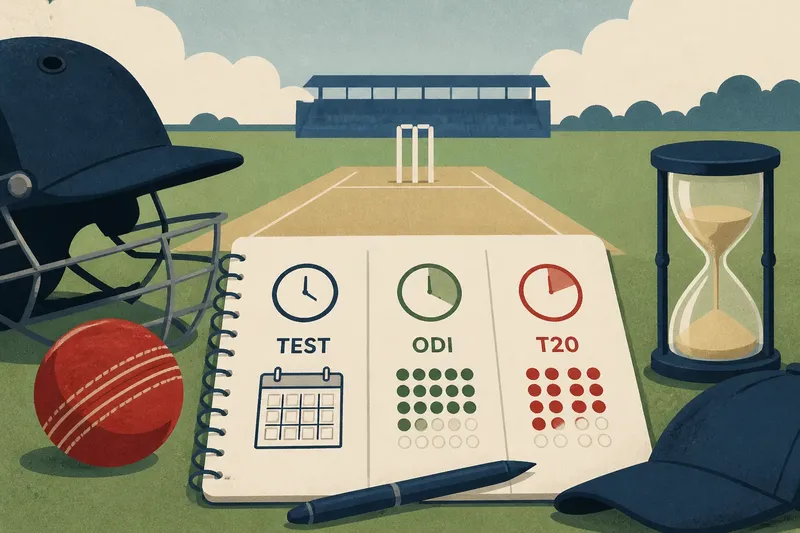
What does the clock mean in a cricket match when nobody is counting down to zero? Cricket match formats answer that question in different ways: some measure opportunity by innings and time, while limited-overs games give each team a fixed supply of overs. Once you know which clock is running, the score and the state of play become much easier to read.
The innings as a clock
In cricket, an innings is a team’s turn to bat. The batting side scores runs while the fielding side tries to dismiss batters and bring the innings to an end. An innings can finish because the side has lost its available wickets, because its allotted overs have been used, or because the match rules provide another way for it to close.
That means an innings is not always a fixed block of elapsed time. In a long-form match, a team may bat for a long stretch or declare its innings closed before losing all its wickets. The opposing team then gets its turn to bat. The match clock is shaped by the innings, the available playing time and the contest between the sides.
Think of an innings as a supply of batting opportunity, not simply a timer. A team can try to use that opportunity carefully, or accept risk to score faster.
Overs as a clock
An over is a set of six valid deliveries bowled by one bowler from one end of the pitch. After the over, another bowler delivers from the opposite end. The change of ends helps organise play, but for a viewer the important point is that overs are countable units of opportunity.
In limited-overs cricket, each team has a set number of overs available in its innings, subject to match conditions. A side can be dismissed before using them all; otherwise, the innings ends when the allocation is complete. The batting team must weigh scoring against the risk of losing wickets, while the fielding side tries to make each remaining delivery harder to exploit.
When a broadcast shows an over count beside the score, read it as a measure of how much of the innings’ allotted supply has been used. It is not the same as minutes elapsed. Delays, changes of bowler and the pace of play can affect how long those overs take.
Three format clocks?
How does a Test match use time?
Test cricket is organised around two innings for each side in the usual match structure, with play spread across scheduled days. Teams can declare, and a match may end in a win, a tie or a draw if the available time runs out without a decisive result.
What makes a one-day match different?
In a one-day international, each side normally has one innings with a fixed allocation of overs. The format gives the contest a defined batting opportunity, so a team’s score has to be judged against both wickets lost and overs still available.
How does T20 shorten the contest?
T20 uses a smaller fixed allocation of overs per side than a one-day international. The same basic innings logic remains, but each delivery represents a larger share of the batting side’s limited opportunity, which encourages sharper attention to the score and the remaining overs.
Reading the scoreline
A score such as 142 for 4 after 18 overs tells you three different things: the side has scored 142 runs, lost four wickets, and used 18 overs. In a limited-overs match, compare that over count with the innings allocation to see how much of the batting opportunity remains. The number of wickets still available helps explain how freely the batters might take risks.
In a multi-innings match, the scoreline needs more context. You may need to track which innings is underway, what each team has scored in earlier innings, and whether the match is moving toward a target or a draw. A single total does not tell the whole story.
Say you join a limited-overs match with a side on 90 for 2 and the broadcast shows that a large share of its overs remains. The score is not automatically strong or weak; notice how many wickets are intact and how quickly the side is scoring. As the remaining overs shrink, the same run rate can call for a different approach.
When an over changes
Not every delivery counts toward the six-ball over. Wides and no-balls are examples of illegal deliveries that generally require an extra ball, although the precise rules for additional penalties vary by delivery and format. A displayed over can therefore include more than six balls bowled, even though only six valid deliveries complete it.
This is why a score such as 12.3 overs is not a decimal number. It means 12 completed overs and three valid balls into the next over. The notation is a compact count of deliveries, not a fraction of an hour or a percentage of the innings.
When an over looks longer than expected, check whether an extra delivery has been bowled rather than assuming the clock is wrong.
Interruptions and revisions
Rain or another interruption can reduce the playing time available. In limited-overs cricket, officials may revise the overs available to one or both teams and set or adjust a target under the competition’s rules. A target should therefore be read alongside the current allocation, not treated as if every interrupted match still follows its original schedule.
Long-form cricket responds differently to lost time because a result depends on the innings and the match’s remaining playing time. A delay can leave less room for teams to complete their turns, which may make a draw more likely. The score itself has not changed, but the time available to turn it into a result has.
For a live match, use the on-screen target and overs allocation after an interruption; the original figures may no longer describe the contest.
What should you watch next?
Why does a team declare?
A declaration ends a batting side’s innings voluntarily in formats that allow it. A captain may decide that the team has enough runs and should give the opposition a chance to bat while leaving time to pursue a result.
What does a required run rate tell you?
In a chase, the required run rate describes the scoring pace needed to reach the target with the remaining overs. It is a guide to the task, not a prediction: wickets in hand and the batters at the crease also shape what the side can attempt.
Why can a match end without a winner?
A draw is possible in long-form cricket when the scheduled time expires before either side secures a win, even if one team has scored more runs overall. A tie is different: the teams finish level under the match’s result rules.
Keep both clocks visible
When you tune in, identify the format first. Then ask whether the active innings is limited by a fixed allocation of overs, by the innings structure and available match time, or by a revised target after an interruption. Those questions tell you what the batting side is trying to preserve and what the fielding side needs to take away.
Cricket’s different match clocks do not make one format a faster version of another in every sense. They change what counts as a scarce resource: remaining overs, wickets, innings or playing time. Keep those limits in view, and a quiet spell, a late surge or a declaration will make sense as part of the format rather than an isolated event.